
In-house SEO vs. agency? How to decide
- Opinion
- SEO

Read time: 7 minutes
AI search is quickly becoming one of the biggest conversations amongst businesses at the moment, so you’d be forgiven for thinking that you’re falling behind if you don’t immediately invest in AEO and GEO strategies. The reality is that, while some businesses with highly AI-engaged audiences may benefit from exploring these strategies sooner, strong SEO foundations are still the biggest driver of visibility, and AI search is building on them, not replacing them.
TL; DR:
Search is changing, and so is the way people find information online. Instead of typing a few words into Google and clicking through a list of websites, more people are asking AI tools detailed, conversational questions and expecting a direct answer. Rather than searching for something broad like “accountant near me”, someone might ask:
“I’m a small business owner earning £100,000 a year. What tax planning strategies could make my finances more efficient?”
This type of search is much more specific. It’s a very different way of searching. People aren’t just looking for a business anymore; they’re looking for expertise and a trustworthy answer.
That’s why terms like AEO, GEO and AI search optimisation have suddenly arisen. As businesses look for ways to appear in AI-generated answers, it’s easy to assume that traditional SEO is outdated. However, it absolutely is not!
Many of the things that have always helped websites perform well in search – creating genuinely useful content, demonstrating expertise, maintaining a technically sound website and building authority – are the very same signals AI systems use to understand and trust your business.
So before you start worrying about optimising for AI search, it’s worth making sure you’ve got the fundamentals right…
The biggest mistake we’re seeing is businesses stress-investing in AEO and GEO services before they have the basics of SEO properly in place. It’s understandable, AI search feels new, exciting, and urgent. But investing in advanced optimisation strategies while your website has technical issues, weak content, or poor authority signals is like trying to build the roof before you’ve built the house… or worse, buying the sofa!
AI assistants are still looking for a lot of the same things search engines have always valued: useful information, trustworthy sources, clear structure, and content that genuinely helps users.
The core SEO tactics every business should prioritise that influence AI visibility:
Your website needs to be easy for search engines and AI systems to crawl, understand, and access. This includes fixing technical errors, improving site speed, ensuring mobile accessibility, and creating a strong technical foundation.
Content remains one of the biggest drivers of visibility. However, simply answering “what is…” queries or repeating information that already exists online won’t cut through. The best-performing websites add something new to the conversation by sharing expertise, original insights, and genuinely useful guidance.
Search engines and AI systems increasingly look for evidence that your business understands its subject area. Creating comprehensive content around your key topics helps establish credibility.
A logical website structure helps both users and machines understand what your business offers and how different pieces of content connect.
Internal links help distribute authority across your website and create clearer relationships between your pages. They also help AI systems understand the connections between your content by following the links between related topics, pages, and supporting information. This creates a clearer picture of your expertise and helps machines understand how different pieces of content fit together.
Experience, Expertise, Authoritativeness, and Trustworthiness (E-E-A-T) are Google’s framework for assessing the quality and credibility of content. It looks at whether content is created by someone with genuine knowledge or experience, whether the source is recognised as authoritative, and whether users can trust the information being provided. These signals strengthen your visibility across search.
Schema markup and structured data give search engines additional context about your content, making it easier to interpret and, in some cases, increasing your visibility across different search experiences.
User experience matters. Slow or difficult-to-use websites create barriers for both people and search technology.
These aren’t just “traditional SEO” activities. They are the building blocks that make your website understandable, credible, and useful.
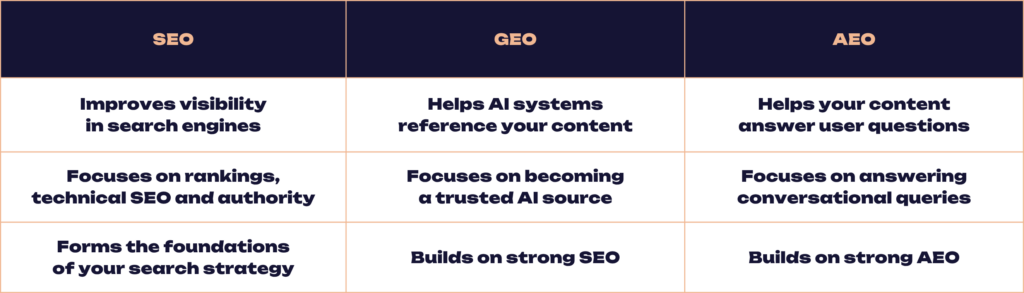
This is where things often become confusing. The terms GEO, AEO, and AI SEO are frequently used interchangeably, but while they are closely connected, they are not exactly the same thing. The easiest way to think about them is as layers that work together, rather than replacements for one another. Think of your search strategy like a Victoria sponge.
It’s the essential foundation that holds everything together. Without a strong SEO strategy, there’s no solid base for your online visibility. Your website still needs to be technically sound, easy for search engines – whether that’s Google, Bing or ChatGPT and Claude – to understand, full of useful content, and backed by authority signals.
Generative Engine Optimisation focuses on building the overall trust and authority that helps AI systems recognise your business as a reliable source.
While AEO is about providing the specific answers AI can extract, GEO is about strengthening your wider digital reputation so AI models are more likely to cite, recommend, and reference your brand.
To optimise for GEO, businesses should focus on:
In simple terms, GEO helps AI systems understand who you are, what you’re known for, and why they should trust you.
Answer Engine Optimisation focuses on creating content that directly answers the questions users ask through AI tools and answer-based platforms.
The goal is to provide clear, extractable information that AI systems can pull into their responses. This means moving beyond simply targeting keywords and creating content that answers specific questions in a direct, useful way.
As users increasingly ask longer, more conversational queries, businesses need to create content that mirrors the way people naturally search.
AEO strategies include:
In simple terms, AEO helps AI systems find the right answer from your content, while GEO helps them understand why your business is a trusted source to recommend.
Like a Victoria sponge, every layer has a purpose. SEO provides the structure, AEO helps deliver the right answers, and GEO builds the trust that makes AI systems more likely to choose your business.
The answer depends on where your audience is and how they search.
✅ Yes, if:
❌ Not yet, if:
AI search should be a proportional investment – not an abrupt budget shift. For many businesses, the biggest opportunity right now is still improving the fundamentals that will support every type of search visibility in the future.
The future of search isn’t SEO versus AI search. It’s SEO, GEO and AEO working together.
People are no longer discovering businesses in one place, they’re searching through Google, AI assistants, voice search and an increasing number of digital platforms. That means success is no longer about ranking first on one search engine. It’s about becoming the most useful, trustworthy and visible source of information wherever your audience is searching. That’s what we mean by a search-first approach. Build strong SEO foundations first, then adapt your strategy to meet changing search behaviours as new technologies emerge.
To The Point is a quarterly search-first digital marketing newsletter packed with useful tips, tools and industry updates you should know about, including: