
Should I be jumping on AI Search?
- Opinion
- Search
- SEO
For the past year, we’ve been drowning in buzzwords: GEO, AEO, LLM optimisation, AI-first content architecture, prompt engineering…the list goes on. Now, Google has FINALLY released its official guidance on optimising for GenAI in Search, giving businesses their clearest indication yet of what actually matters in Google’s AI-powered search experiences like AI Overviews and AI Mode. We are here to break it down.
Here’s what matters, what doesn’t and what you should do next.
This blog covers:
If you were expecting Google to reveal some revolutionary “AI ranking system” that changes everything…Sorry. Google makes it clear that optimising for GenAI search experiences still relies on established SEO principles:
There’s no separate playbook being introduced here, these principles still form the foundation of visibility in both traditional search and AI-generated results.
So despite the new terminology floating around, the underlying reality hasn’t really changed. If your SEO isn’t strong, nothing else is going to sit on top of it and fix that.

via Giphy
One of the more noticeable myths Google has quietly shut down is the idea that websites need an llms.txt file – essentially a file designed to help large language models understand your content. This has been doing the rounds for a while, with people testing whether adding dedicated files for large language models has any impact on visibility or interpretation. Some people swore it would become essential, others thought it was complete nonsense. (We were leaning heavily towards the second one.)
Google’s position is simple: it’s not required.
Another myth Google quietly killed: you need to “chunk” your content into tiny blocks so AI can process it. Google says there’s no need to artificially restructure content specifically for AI systems.
That said, this is where nuance matters. While you don’t need to completely restructure content into rigid AI-friendly blocks, the idea of “answer-first” content still holds up. Content that is clear, direct and structured around real user intent tends to perform better across both traditional and AI-driven search experiences.
So it’s not about formatting for AI. It’s about removing friction from understanding.
Another clear message: there’s no requirement to introduce experimental or AI-specific structured data.
Google’s advice is to sticktick with the structured data that already works and forms as part of a good SEO strategy to get you featured in Rich Results:
In other words, this isn’t a moment for reinventing structured data. It’s a reminder that the basics still work when they’re implemented properly. Which, reassuringly, is exactly where most good SEO strategies already sit.
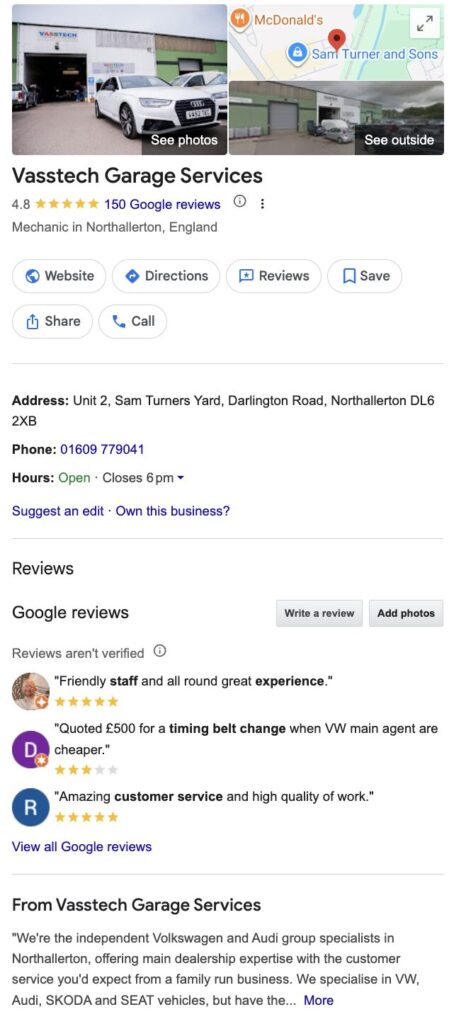
Generative AI responses can include product listings, product information, and information about local businesses, which means that your Google Business Profile needs to be in good shape. If AI systems are being used to surface recommendations, compare providers, or summarise options, then structured and reliable business information becomes critical. Make sure your contact details, name and address are consistent with what’s on your website, your categories and services meet search demand, your reviews are consistently trickling in and that your profile is active and fresh with posts and photos.
So if your Google Business Profile hasn’t been updated since someone uploaded a blurry office photo in 2017…that will be a problem. Local SEO was already important and AI search makes it even more valuable as a core visibility layer.
This is arguably the most important part of Google’s guidance.
Google spends a huge chunk of its guidance talking about something called non-commodity content. This could change how brands approach content entirely. They draw a clear line between generic, widely available content and content that is grounded in real, unique experience.
Google’s example of commodity content: “7 tips for first-time homebuyers.”
Helpful? Sure. Unique? Not really. Anyone could write it, and there’s probably 30 other blogs just like it sitting in the Google SERP
Now compare that to their example of non-commodity content: “Why We Waived the Inspection & Saved Money: A Look Inside the Sewer Line”. Now that’s different.
That’s:
Content which aligns with Google’s E-E-A-T is content AI systems actually want to reference.
And this is where a lot of brands will need to shift. AI systems can summarise generic information from their training data, without the need to head to your site. What they’re far less good at replacing is actual experience, nuance and real-world detail. This is where we need clients to lean in more. Not “set and forget” content, but stories that come from inside the business. Clients often expect to appoint a marketing partner and have content handled entirely for them, but the reality is it works best as a collaboration – they bring the insight and expertise from inside the business, and we turn that into polished content that performs.
We need stories. Real ones, like:
AI can mimic your expertise, but not your lived experiences! And increasingly, that’s the kind of content Google seems to be rewarding. AI doesn’t just want information anymore. It wants perspective.

And this one’s definitely worth watching.If you’re wondering what that means: browser agents and AI assistants may start interacting with websites on behalf of users.
Google breaks this down into three ways agents understand a site:
Basically, AI might not just read your website, it might start using it. That could mean an AI agent visiting your website, understanding what’s on the page, comparing options, filling in forms, navigating product journeys or helping a user complete a task without the user manually clicking through every step.
This matters because traditional SEO has mostly focused on whether search engines can crawl and understand your content. Agentic experiences add a new question: can an AI assistant actually understand and navigate your website like a user would?
It’s early, and there’s still a lot of uncertainty around what this looks like in reality.
Google does suggest businesses should start paying attention to agent-friendly webdesign, even if the full implications aren’t fully defined yet.
Right now, it’s early days. We’re not pretending there are clear answers. But there are practical things worth reviewing now:
But the fact that Google has mentioned it as one to keep an eye on, it’s definitely worth paying attention.
Now that Google has released its GenAI search guidance, the direction is clear: the fundamentals of search haven’t changed, but expectations have. SEO evolves all the time, and the GEO era is just another way for us to adapt to show up on these new platforms. GEO is fundamentally the same as SEO, but the bar for what counts as “good” content has gone up. Generic, surface-level content will find it harder to surface in both traditional and AI-driven results.
The focus is shifting towards real substance – experience-led content, specific examples, and insights that can’t be easily replicated or summarised.
In short: not more content, better content.
The businesses that adapt won’t be chasing every new AI acronym. They’ll be the ones already doing the basics properly, and backing it with something genuinely useful.
To The Point is a quarterly search-first digital marketing newsletter packed with useful tips, tools and industry updates you should know about, including: