
Should I be jumping on AI Search?
- Opinion
- Search
- SEO

Hello, this is an alert for all of our previous clients and welcome to ODN if you’re new here. In light of the fact that search has changed, AI is changing how content is found and surfaces, AND users are expecting answers faster with less effort and more clarity than ever, we’d thought we’d ask one simple question: ‘Is your website keeping up?’
We thought we’d ask if you’d like any improvements… before things start to fall behind the trends.
This blog will cover:
Search has changed dramatically. Journeys are no longer linear. Users don’t start at the top and work their way through a website – they jump between search results, they discover on social platforms like TikTok, Instagram and Facebook, they compare options quickly, and expect to find what they need without effort.
At the same time, expectations have shifted. People want faster answers, clearer information, and content that gets to the point. Search engines are adapting to this too, increasingly using AI to interpret and surface content based on relevance and clarity, not just keywords.
As a result, it’s not just about being found. It’s about being immediately useful when you are and that’s where many websites start to fall behind.
Schema is a behind-the-scenes layer that can have a big impact on your website’s performance. Making sure search engines and AI agents understand your content and serve it to the right users, at the right point of their journey can help both traffic and click-through rates (CTR). It works by adding structured data – giving more context than standard SEO elements like heading tags, focus keywords and meta descriptions which already provide signals.
Schema helps search engines understand exactly what your content is about, which can lead to more accurate rankings and improved visibility in search results.
For multi-location or local businesses, this becomes even more valuable. Clearly defining locations, services, and key business information through structured data makes it easier so users are matched to the right page. It also enables rich results – things like review stars and FAQs – making your listing more visible and more clickable.
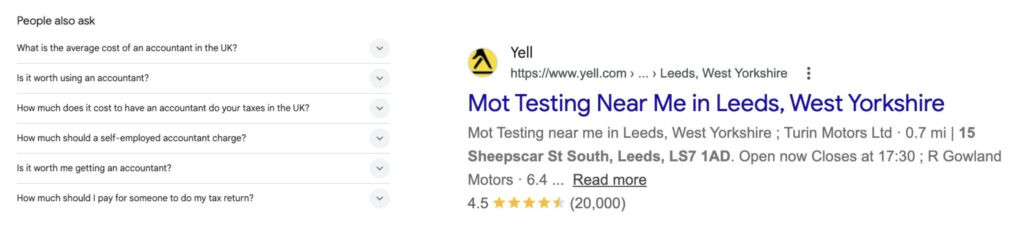
How people consume content online has changed. Very few users are reading from start to finish anymore, and search engines are no different. Both want information that is easy to scan, easy to understand, and easy to extract.
That’s where content structure comes in. The way your content is laid out directly impacts how effective it is – not just for users, but for search visibility too. We focus on structuring content so the answer comes first. That means users don’t have to scroll through an entire page just to find what they came for – it’s immediately clear at the top.
Leaning into question-based headings is also beneficial. Instead of guessing what someone might want to know, match the way they actually phrase their queries. From there, it’s about hierarchy. Clear H1, H2, and H3 structures help both users and search engines understand what matters most on the page and how everything connects. And when it makes sense, we break content down further using lists and tables – because sometimes the best way to explain something is simply to make it easier to scan.

For businesses operating across multiple locations, visibility needs to extend beyond a single homepage. A scalable content structure allows each location to exist clearly within the website, with dedicated pages for services, contact details, opening hours and location-specific information. This helps search engines understand each branch individually, rather than treating the business as a single entity. The result is more accurate local visibility and improved relevance in location-based searches. Read more about this one our blog.
Many websites generate traffic but provide limited visibility into what happens next.
Conversion tracking focuses on understanding user behaviour – where visitors come from, how they interact with the site, and what leads to meaningful actions, using tools like Google Analytics and platform specific tracking. Without this, it’s difficult to understand performance beyond surface-level metrics. With it, decisions are based on actual user behaviour rather than assumptions.
People aren’t just reading anymore, they’re watching.
Video has become a core part of how content is consumed; quick social clips or more educational, blended “edutainment” style content. Used well, it acts as a hook. It draws people in, explains things faster, and keeps them engaged on the page.
Video can be used in different ways on a website. In some cases, it’s informative and longer form or simply to add some dynamism to pages In others, it simply adds movement and clarity to key pages, helping to explain ideas more effectively than text alone.
It’s no longer something to avoid due to performance or technical concerns. Improvements in devices, connectivity and hosting mean video can be used without slowing things down or complicating the experience.
Done right, it adds depth, clarity, and another way for users to engage with your content.
Websites are no longer static experiences. Entry transition for content can make a website more engaging and fresh without always needing a lot of work. Subtle movement, button rollovers and micro-interactions contribute to how modern and intuitive a website feels.
These small details don’t change the message, but they do influence how the experience is perceived.
Now AI is summarising information, unique content is more important than ever.
Content that includes perspective, POVs, experience, or first-party data is more valuable – both to users and to search systems that prioritise useful, differentiated information. It aligns with Google’s E-E-A-T principles, which are increasingly used to assess the quality and credibility of content. If a website doesn’t add anything new or meaningful, it becomes harder to stand out in search.

Tired of having to ask a developer to update a heading, swap an image, or tweak a section to part of your website?
There’s a good chance that content doesn’t need to be locked away. A lot of it can be moved into your CMS – giving you control to make quick changes without the back-and-forth.
Less waiting, fewer costs, and a website that’s actually easy to keep up to date.

Accessibility doesn’t have to be an all-or-nothing approach. While there are clear standards in place, even small improvements can make a meaningful difference to how accessible your website is.
It’s not about including everything or adding features like sign language within videos. In many cases, simple changes such as providing transcripts or adding clear alt text to images can significantly improve usability.
Other practical considerations include ensuring the site is navigable by keyboard – for example, being able to tab through menus, skip to the main content, and move through pages without a mouse.
Small adjustments like these, alongside things like readable contrast and clear structure, make websites easier to use for a wider audience. And while they’re often framed as accessibility improvements, they tend to improve usability for everyone.
Don’t get overwhelmed. You don’t need everything, but you probably need some updates.
Search has changed, user behaviour has shifted, and expectations are higher. From how your site is found, to how content is structured, to how users engage and convert — small gaps can start to add up.
Most websites don’t need a full overhaul. They just need the right improvements in the right places.
And if you’re not sure where that is, we’re here to help.
To The Point is a quarterly search-first digital marketing newsletter packed with useful tips, tools and industry updates you should know about, including: