
Should I be jumping on AI Search?
- Opinion
- Search
- SEO

Local SEO works – but for many multi-branch SMEs, scaling it well is the real challenge.
As businesses expand across locations and services, it’s easy to assume success in one area should translate automatically to the rest. In reality, limited time and unclear prioritisation often dilute authority, making it harder for Google – and clients – to understand what each office is truly known for.
This blog explores:
When someone searches for a local service, Google often shows a map with a short list of businesses before the normal search results. This is known as the Map Pack (or Local Pack). It usually displays three nearby firms, along with their reviews, opening hours and contact details.
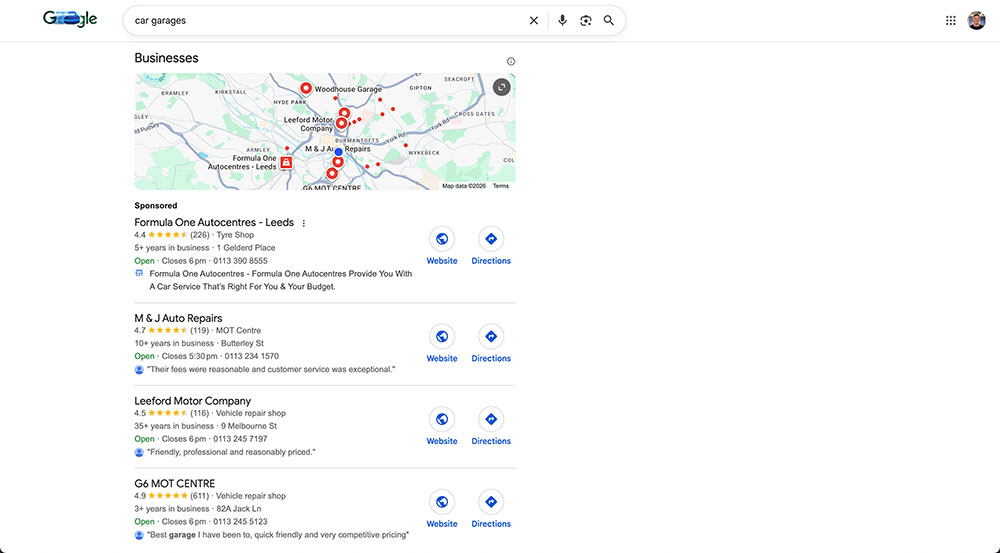
For many local searches, Google shows a Local Pack – a map with what it sees as the most relevant local businesses for your local query, all before you reach the traditional organic results. This area attracts a disproportionate share of attention, with 44% of local searchers clicking the Local Pack top 3, compared to 29% organic. That means being present here is key.
Google ranks businesses in the Local Pack using three core factors:
Today, Google is trying to understand who is best placed to solve a specific problem in a specific location. Distance still matters, but intent, expertise and trust play a much larger role in determining which firms appear, and which actually convert.
You can read Google’s own explanation of its Local Pack ranking factors here.
A familiar pattern emerges with many growing professional services firms. They have multiple offices, offer a wide range of services in several practice areas, and have built pages to support all of them. On paper, everything looks reasonable. Rankings exist. Visibility is spread across locations. Impressions grow. Nothing appears obviously broken.
But what’s missing is clear leadership. Search rewards focus, not broad, thin coverage. When authority is diluted across many locations and services, firms remain visible but rarely stand out as the best answer to a specific query.They’re present in results, but not clearly deserving of the top positions.
And this isn’t just a problem for Google.
For professional services like law and accounting, people aren’t choosing purely on proximity or convenience. They’re choosing the provider they trust – the one that feels safest, most credible and most capable of handling complexity. Generic service pages may generate visibility, but they struggle to convert that attention into confidence, and confidence into enquiries.
For multi-branch SMEs, fixing local SEO isn’t about doing more. It’s about making sure what you do is done well.
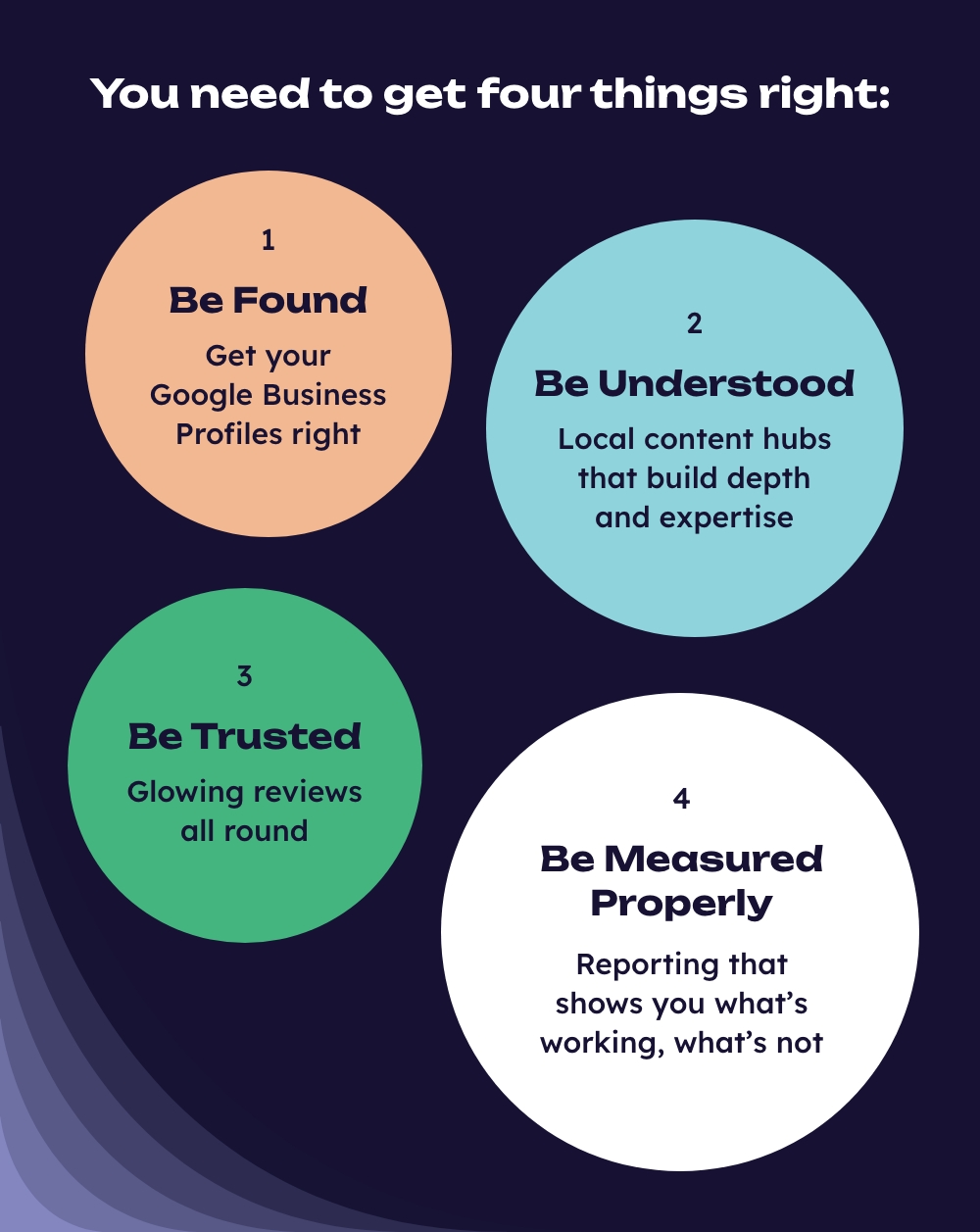
Every physical office needs its own verified Google Business Profile. While service-area businesses that need to travel to clients, such as a window cleaning or plumbing business, follow slightly different rules, professional services firms with real offices – for example, a law firm with ten branches – should create a separate profile for each office. Each one needs to be accurate, complete and consistent across every location.
This starts with NAP (Name, Address, Phone Number) consistency – where these details must match exactly across your website, GBP and other places your business might appear, such as your social media channels or directory listings/
Category selection has a major impact, particularly your primary category. Choose the one that best reflects your core service (for example, “Accountant” rather than something vague), then support it with services that align to real client demand. Opening hours should be accurate, including bank holidays. Each profile should also have a unique description, location-specific photos, and regular updates.
It’s also important to remember that strong performance in one location doesn’t automatically transfer to others. Every branch is assessed on its own signals. That’s why reviews matter at a local level – not just collecting them, but responding to them too. Google wants to see that you engage with your community! Well-maintained, consistent profiles make it easier for Google to understand each office, and easier for potential clients to trust what they’re seeing.
A common question we hear is: “Should each office have its own website?”
For nearly all professional services firms, the answer is no. Multiple websites split your authority, increases the workload and risks involved in maintenance, and ultimately makes it harder to build a consistent, recognisable brand. A much stronger approach is to focus on a single, authoritative domain that’s organised with a clear structure reflecting both your locations and your service expertise, i.e.
Many firms rely on one generic “Our Offices” or “Contact Us” page alongside multiple GBPs. That setup limits how well Google, and users, can understand what each office actually does. What works far better is dedicated local service pages: one page per service, per location, even when services overlap. Crucially, these pages need genuinely unique content, not templated variations where you’ve changed the location modifier.
Strong location pages typically include:
This level of specificity also helps avoid cannibalisation, where nearby offices compete for the same keywords. Clear service-and-location targeting ensures each page has a distinct role in search. For professional services, this depth matters. Buyers aren’t just looking for availability – they’re looking for reassurance. They assess judgement, experience and risk, and different services are researched in different ways.
Treating every service with identical structure and messaging limits performance.They aren’t quick wins, and they take time to mature, but they are one of the most reliable ways to move from broad visibility to genuine authority, without diluting focus as the business grows.
Google Business Profiles are essential, but they can’t carry a multi-branch strategy on their own. They signal where you are but they rely on your website to provide context, depth and credibility.
For professional services SMEs, reviews play a dual role. They influence map pack visibility, and they act as a critical trust signal at the moment a client is choosing who to contact. .
Reviews also differentiate individual offices, not just the firm as a whole. When prospective clients are choosing between similar providers, reviews often provide the final reassurance, especially for services involving risk, regulation, or long-term commitment.
Getting reviews right isn’t about shortcuts. It’s about generating reviews ethically, responding consistently (including to negative feedback), and ensuring reviews align with the correct location. Do that well, and reviews strengthen both local performance and conversion.
Local SEO performance is often misunderstood because it’s measured in the wrong place.
Website traffic alone doesn’t reflect how local discovery works. Many prospective clients never reach the website at all. Instead, they call directly from a Google Business Profile, request directions via Maps, or view a profile to assess credibility. These actions – calls, direction requests, profile views – are tracked inside Google Business Profile, not in tools such as Google Analytics 4.
To measure local SEO accurately, GBP needs to be treated as a primary discovery channel, not a supporting one. That means tracking engagement per location, and monitoring how individual location pages perform for branch-specific keywords.
UTMs help bridge that gap, by connecting profile clicks back to your wider reporting, while keeping GBP engagement separate to ensure it isn’t lost or misinterpreted.
The local pack and map results account for a significant share of clicks and interactions compared to traditional organic listings. Ignoring them skews reporting and makes it harder to understand what local SEO is actually delivering.
We’ve seen this approach work in practice with our clients, BHP and Vasstech, where prioritisation, authority-led content, and a structured local strategy replaced scattered visibility with sustained growth.
The principle is simple: build authority deliberately, then scale it.
For multi-branch professional services SMEs, good local SEO means:
It’s not about ranking everywhere. It’s about becoming the obvious choice somewhere first.
To The Point is a quarterly search-first digital marketing newsletter packed with useful tips, tools and industry updates you should know about, including: