
Forget SEO, Search is in

Search, the new seo text, slides onto light green screen

You may have noticed we have repositioned ourselves as the ‘Search-first, digital agency’. This isn’t just a tagline refresh – it’s a shift in how we think about visibility, discovery and how people actually find the things they want online in 2025.

People don’t just Google anymore.
They TikTok it.
They ChatGPT it.
They Instagram it.
They ask Reddit.
They look on Pinterest.
They ask AI.
They voice search.
They even ask WhatsApp messages and DMs.

SEO hasn’t died, it’s just changed. SEO as we’ve always known it felt limited to Google, but nowadays, it is channel-agnostic and platform-fluid. Instead of chasing Google’s algorithms, we’re following humans and where they’re searching. And this blog unpacks exactly what that evolution looks like – for us, for SEO and for every channel where people now search.
The evolution of SEO

a silhouette of the different stages of human evolution in a row on purple crumpled background with a white skull in each corner

via Giphy

SEO used to feel a lot simpler: pick your keywords, build authoritative backlinks, optimise your meta data, and hope Google approved (Well, there was a lot more to it than that – but that’s the basics). Back in the day, page-one rankings were the goal, and you got there by ticking technical boxes making sure your site was optimised for Google’s algorithm, not necessarily to your users.

Those days are over.

Today, audiences don’t just ‘Google it’ anymore – they scroll, ask, watch, and chat on various platforms. And that means that SEO has expanded, and we must optimise and be present on more platforms than just Google. The goal isn’t “ranking” anymore – it is to show up where your audience is searching. And that’s where Search as a service comes in. But what’s the process for optimising for Search?

The End of SEO Tricks

Shortcuts and hacks, keyword stuffing, link schemes and grey-area tactics also don’t work anymore. Audiences and algorithms see straight through them.

What works now?

  • Real expertise
  • Useful, well-crafted content
  • Strong user experience
  • Consistency and clarity
  • Search today rewards quality, not cleverness.

woman with ginger hair looking through binoculars

via Giphy

Firstly, where exactly are people searching?

There are many places that people could be searching. It’s unlikely that your audience will be on every platform, so it’s about doing the right research to determine where they’re present. However, a few places they might be include:
  1. AI Summaries: AI search is blurring the line between searching and simply getting an answer. Now, people turn to tools like ChatGPT, or Gemini for actual, direct answers (no longer the blue links :().
  2. AI Search: Users are no longer simply asking questions, they’re having full conversations with AI. They ask follow-ups, request clarification, compare alternatives and refine their intent in real time. This shifts search from a single query to an entire user journey.
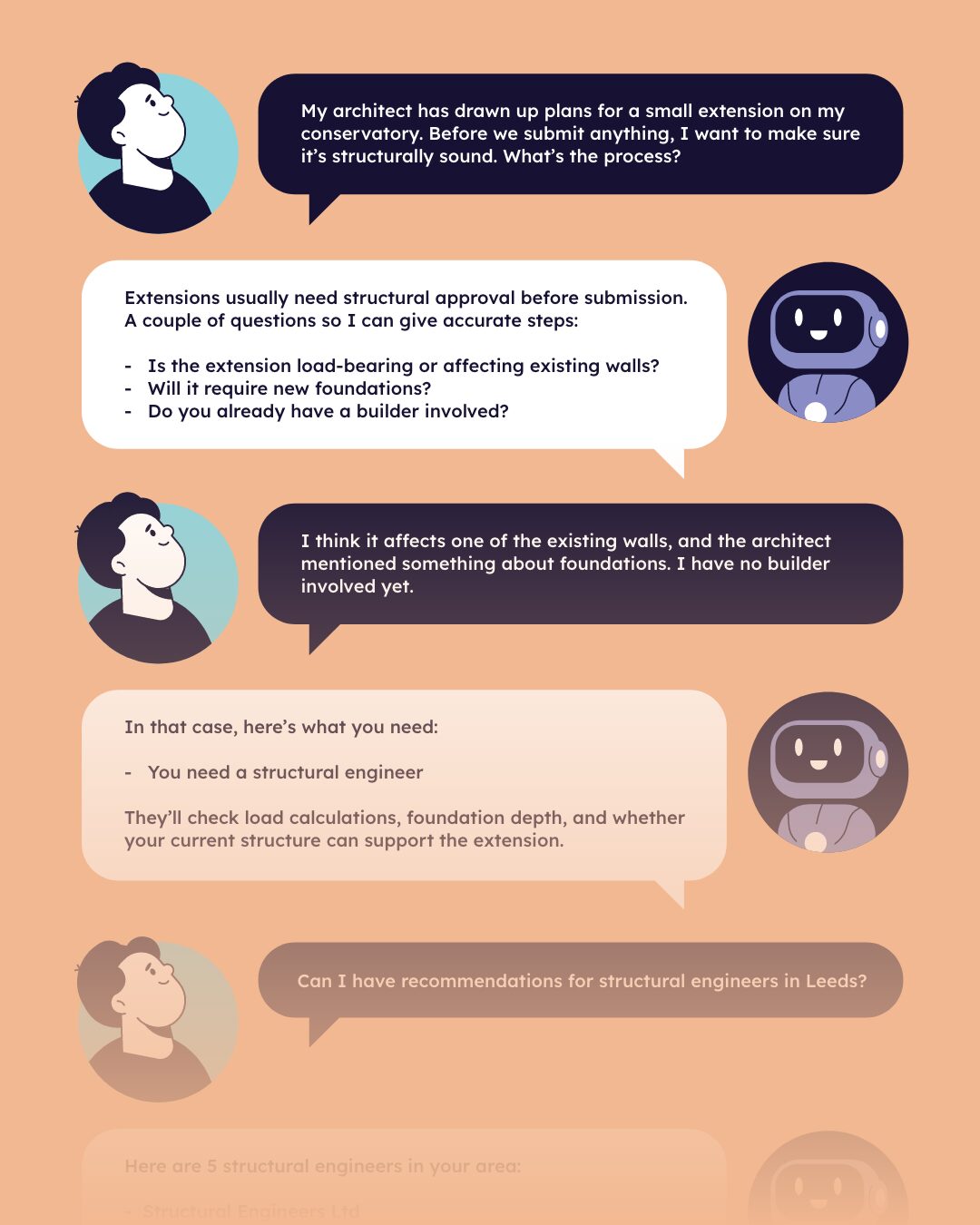
    Instead of typing “structural engineer in Leeds” into Google using as few words as possible (the old SEO mindset), people now speak naturally:“I’m renovating a property- what kind of structural engineer do I need? What should I look out for? Can you compare options near Leeds? Which ones have the best reviews? Who’s best for tricky renovations?” Check out this example:
  3. Social Search: TikTok and Instagram now function as search engines in their own right, especially for younger audiences. People want visual, quick, to-the-point content, from tutorials to reviews of services and products. Engagement and watch time dictate visibility far more than classic keyword optimisation.
  4. Community Search: Reddit, Discord, Quora and niche forums are where people go for opinions and trusted recommendations from real users. These communities heavily influence perception and often rank highly on Google too. Your reputation here matters.

How can my brand show up on these surfaces?

Modern visibility means showing up wherever your audience looks for answers. Every platform must be thought of as its own search ecosystem, because every platform has its own rules, its own signals and its own version of credibility. To be visible, you need to understand each platform’s values and create content that works with those signals.

AI Search Tools (ChatGPT, Gemini, Claude)

AI search doesn’t “rank” web pages- it collates, interprets and summarises information from across the internet. It looks for well-structured, trustworthy content. To show up in AI results, brands must focus on:

  • Schema & structured data: This helps AI understand your content. Clear schema, definitions and structured product or service information can make your brand easier for LLMs to evaluate and reference.
  • External credibility signals: Only 5% of the information AI collects about you comes from your website, the rest is from reviews, ratings, third-party mentions, PR, interviews, partner content, podcasts. Through external mentions, AI can verify that you are trusted beyond your own website.
  • Authority-driven content: AI tools prefer content that is factual, concise and expert-led. This could be demonstrated by linking a blog for example to an author profile which contains relevant industry experience.
  • Consistency: Ensuring your brand is consistently described across the web so AI models have a stable “entity profile” to draw from.

TikTok Search

TikTok is no longer just a social channel but a search system where users look for how-tos, recommendations, reviews, inspiration and expertise.

TikTok values watch time, replays, completion rate, saves and shares, comments and conversation. To earn those signals, you need human-centred content, not SEO-style optimisation. To show up on TikTok search, you need:

  • A hook: capture your audience in the first 2-3 seconds with a problem they may be having.
  • To edutain: provide a solution to that problem in an entertaining but educative way.
  • Human voice: TikTok rewards authenticity, use personality, a face and voice.
  • Use natural language keywords: TikTok transcribes and indexes phrases like “here’s how to” or “if you are looking for”.
  • Format for search intent: create content that mirrors what people actually search for on the platform e.g. tips, howtos and best tools.

LinkedIn Search

LinkedIn is a discovery engine for B2B brands, experts and creators. Its algorithm rewards: consistency, professional credibility and meaningful engagement. To show up on LinkedIn:

  • Share original insights, not just repeating other’s industry opinion
  • Have a clear, searchable positioning, for example a clear, engaging headline
  • Post consistently- 2-3 posts a week
  • Encourage conversation
  • Create skimmable, value heavy posts- like carousels or infographics.

Community Search

Community-driven platforms, like Reddit, are not places to sell. They enforce a very strict zero-tolerance policy against spam and self-promotion. Users hate to see brands pushing sales in these spaces. These platforms are built on genuine, user-user interaction, ensuring trust and authenticity.

However, this does not mean brands cannot participate strategically. In relevant subreddits or forums, consistent mention can boost brand authority and uncover content. Reddit is all about earning trust, people want genuine answers which demonstrate actual knowledge.

To approach community search:

  • Start as a member: Engage as a normal user before promoting your brand. Comment, share relevant, helpful insights and participate in discussions.
  • Build your profile age and reputation: Having zero posts is a red flag. Invest time in uploading content, start slow and scale it.
  • Focus on adding value: Avoid overt promotion by sharing real, thoughtful knowledge. You will become respected and recognised by other users in the community.

You can’t approach these channels separately. Visibility now comes from turning up consistently and credibly across all relevant platforms.

Graph with an arrow pointing in an upwards trajectory

Metrics that actually matter now

Forget about obsessing over “organic traffic” or “page one rankings.” Search is bigger than that. What really counts now is:

  • Brand mentions: As traditional click-throughs decline, brand exposure becomes key for visibility- and brand mentions (and the context around them) influence how often you appear in LLMs. What are people saying about your brand online? Is it positive? How often do you get mentioned?Backlinks used to be the key (while still very important, just a mention holds weight now). Social media comments, reviews on google, blogs, forum discussions and creator content all contribute to how AI tools understand your brand now.
  • Branded Search for “[Brand] + [Category]” Queries: This goes beyond just branded search volume. You’re measuring brand-category association – we want people to know your brand and associate it with something. Examples: “Nike running shoes”, “Vasstech MOT and service.” Break it down by: Volume and growth trend over time- If people are combining your brand with the category, you’re winning early consideration.
  • Visibility in AI or social search: Instead of ranking positions, you’re measuring surfacing rate in AI search engines: How often your brand is included in summaries, shortlists, citations, “recommended tools,” Does the model output link to you or mention alternatives first?
  • Engagement and conversions from your key conversion pages: With fewer organic clicks overall, the clicks you do get must work harder. You must track performance for critical pages, these may include:
    • Product / service pages
    • High-intent conversion pages
    • Lead generation landing pages
    • Pricing pages
    • Reviews/comparison pages.
  •  Share of Search-  how often your brand is searched compared to competitors:Share of Search shows how often people search for your brand compared to your competitors. It’s a simple way to see how much demand or interest your brand has in the market. You should track your brand’s share of total branded search within your category, how that changes over time, and how your marketing efforts influence overall search interest.

These metrics show how your brand is performing in the wild, not just in one search box.

🔑 The key takeaway: Search as a strategy

Search is no longer something you optimise just for Google anymore. It’s about showing up consistently, building trust and being genuinely useful- wherever your audience is looking. To do this you must optimise natively for each platform, use structured data to help AI tools understand and surface your content and create content that answers real questions, not just fills pages.

Explore how our search-first services can help you optimise your visibility where your audience is searching.
Ready to be found wherever your audience searches? Let’s make your brand visible.

Blog Single
Privacy Agreement